
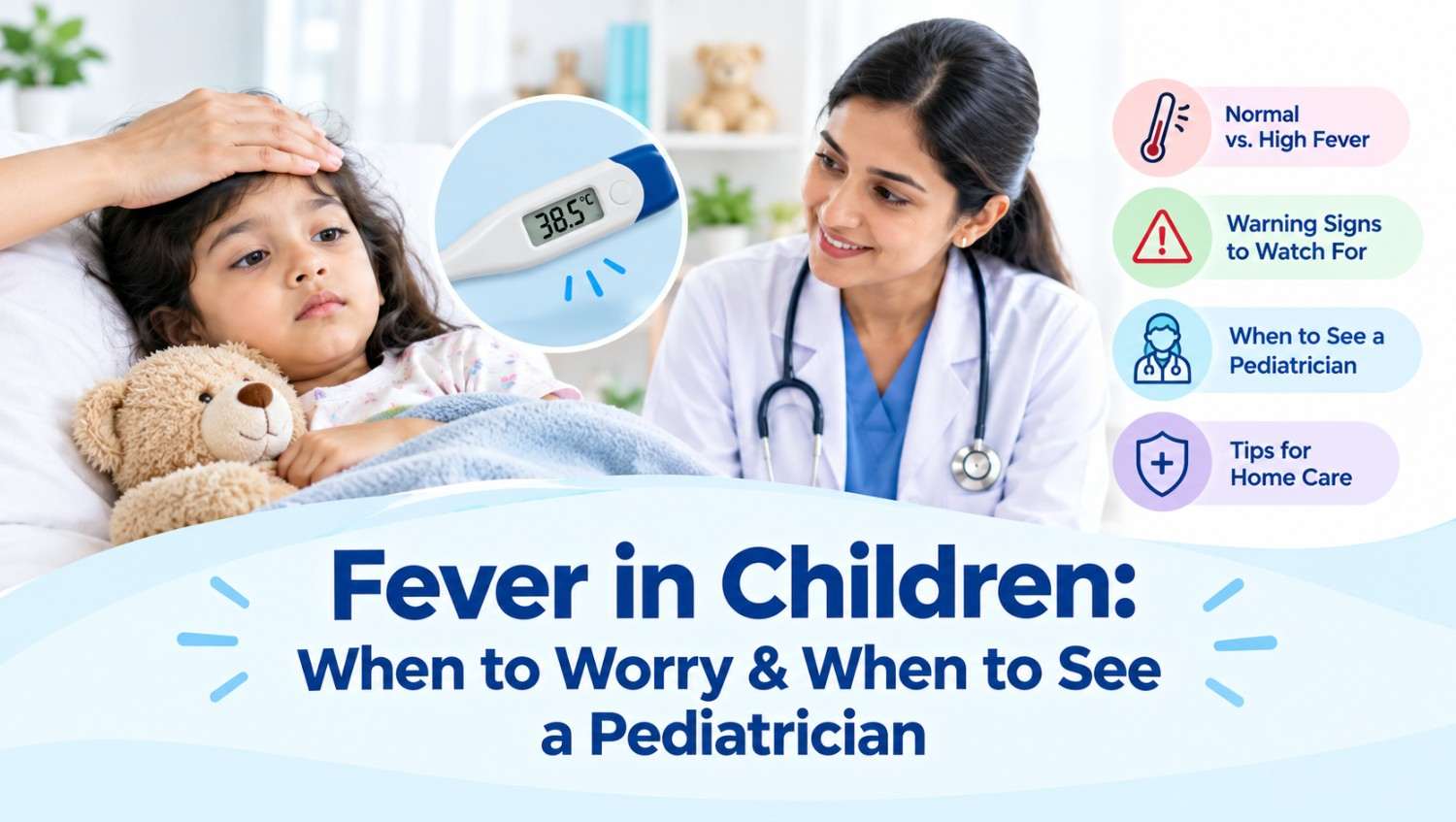
Few things worry parents more than a child with a hot forehead in the middle of the night. The good news is that most fevers in children are caused by common viral infections and settle on their own within two to three days. Fever is actually one of the body's ways of fighting infection. But some fevers do need urgent medical attention, especially in very young babies or when other warning signs appear.
In this guide, the child health team at UniClinic Health explains what counts as a fever, the right fever temperature for each age, how to care for your child at home, and when it is time to see a pediatrician.
A fever is a body temperature higher than normal. A child's normal body temperature is usually around 36.5°C to 37.5°C (97.7°F to 99.5°F), and it can change slightly through the day. In most children, a temperature of 38°C (100.4°F) or higher is considered a fever.
Newborns and young babies can become seriously ill quickly, so any fever in a baby under 3 months always needs a doctor.
· Digital thermometer – the safest and most accurate option for home use. Avoid old mercury thermometers.
· Under the arm (axillary) – suitable for babies and young children; keep the thermometer in place until it beeps.
· Ear (tympanic) thermometer – quick and easy for children over 6 months.
· Forehead (infrared) thermometer – convenient, but confirm a high reading with a digital thermometer.
· Mouth (oral) – suitable only for older children (usually over 4–5 years) who can hold the thermometer under the tongue.
Feeling the forehead with your hand is not reliable. Always use a thermometer and note the reading and time.
1. Viral infections – cold, flu and other viruses are the most common cause.
2. Throat and ear infections – often with throat pain, ear pain or irritability.
3. Seasonal infections in India – dengue, malaria and typhoid are common, especially during and after the monsoon in Kolkata and other cities.
4. Urinary tract infection (UTI) – a common hidden cause of fever in babies and young children.
5. Pneumonia and chest infections – fever with cough and fast or difficult breathing.
6. Stomach infections – fever with vomiting or diarrhoea.
7. After vaccination – a mild fever for a day or two after some vaccines is common and usually harmless.
If your child is active, drinking well and has no warning signs, you can usually care for them at home:
· Give plenty of fluids – breast milk, formula, water, ORS, soups or coconut water to prevent dehydration.
· Let them rest and dress them in light, comfortable clothes. Do not wrap them in heavy blankets.
· Sponge with lukewarm water if they feel uncomfortable. Do not use cold water, ice or alcohol.
· Give fever medicine only if needed – paracetamol can be used for comfort, in the dose your doctor advises for your child's weight.
· Never give aspirin to children, as it can cause a rare but serious condition called Reye's syndrome.
· Avoid ibuprofen if dengue is possible, unless your doctor advises it.
· Do not give antibiotics on your own – most fevers are viral and antibiotics will not help.
The aim of treatment is to keep your child comfortable, not to bring the temperature down to normal at any cost.
Take your child to a doctor or emergency department immediately if they have fever with any of these signs:1,4
· Age under 3 months with a temperature of 38°C (100.4°F) or higher
· Difficulty breathing, fast breathing or chest indrawing
· Unusual drowsiness, difficulty waking up, or being very floppy
· A fit or seizure (convulsion)
· A rash that does not fade when you press a glass against it
· Stiff neck, severe headache or bulging soft spot in a baby
· Signs of dehydration – very few wet nappies, dry mouth, no tears, sunken eyes
· Bleeding from the nose or gums, or severe stomach pain (possible dengue warning signs)
· Bluish, pale or blotchy skin, or cold hands and feet with high fever
· Non-stop crying or crying that sounds unusual
Some children between 6 months and 5 years have a fit (febrile seizure) when they get a fever. It can be frightening, but most febrile seizures stop within a few minutes and do not cause lasting harm.4 Lay your child on their side, keep them safe, and do not put anything in their mouth. Seek medical help right away, especially if it is the first seizure or it lasts more than 5 minutes.
Even without emergency signs, book an appointment with a pediatrician if:
· The fever lasts more than 24 hours in a child under 2, or more than 3 days in an older child
· The fever keeps coming back
· Your child has ear pain, throat pain, pain while passing urine, or a cough that is getting worse
· Your child is not eating, drinking or playing as usual
· There is dengue, malaria or typhoid in your area and the fever is high
· You are worried or unsure – trust your instinct as a parent
A pediatrician may suggest tests such as a complete blood count (CBC), CRP, a urine test or a fever profile to find the cause.
UniClinic has experienced child specialists in both Kolkata and Siliguri.
In Kolkata, parents can consult Dr. Rahul Ghosh, Consultant Pediatrician (MBBS, MD Pediatrics, DCH (UK), MRCPCH (UK), PGPN (Boston)), at our Hazra Road clinic. Visit our pediatrician in Kolkata page to book an appointment.
In Siliguri, you can consult Dr. Paramita Nandi, Child Specialist (MBBS, MD Pediatrics, PGPN), and Dr. Amarlok Kumar, Pediatrician & Neonatologist (MBBS, DNB Pediatrics), through our Siliguri paediatrics service.
· Keep your child's vaccinations up to date, including the yearly flu vaccine.
· Teach regular handwashing with soap, especially before eating and after using the toilet.
· Use mosquito nets, repellents and full-sleeve clothing, and remove standing water at home to prevent dengue and malaria.
· Give safe, boiled or filtered drinking water and freshly cooked food.
· Ensure a balanced diet and good sleep to support immunity.
Most fevers in children are mild and pass within a few days with rest, fluids and care at home. What matters more than the number on the thermometer is how your child looks and behaves. Always seek urgent care for a baby under 3 months with fever, or for any child with warning signs such as breathing difficulty, unusual drowsiness, a seizure or a rash that does not fade.
If you are worried about your child's fever, consult an experienced pediatrician. Parents in Kolkata can visit UniClinic Kolkata – Paediatrics, while parents in Siliguri can consult the UniClinic Siliguri – Paediatrics team.
For babies under 3 months, any temperature of 38°C (100.4°F) or higher needs urgent medical care. For older children, a fever of 40°C (104°F) or higher, or any fever with warning signs such as breathing difficulty, drowsiness, a seizure or a rash that does not fade, needs a doctor right away.
Most viral fevers in children last 2 to 3 days. See a pediatrician if the fever lasts more than 24 hours in a child under 2 years, more than 3 days in an older child, or keeps coming back.
No. If your child is sleeping comfortably, there is no need to wake them to give fever medicine. Rest helps recovery. Give medicine only if your child is uncomfortable, and always in the dose advised by your doctor for their weight.
Paracetamol is commonly used to make children with fever more comfortable, but the dose depends on the child's weight and age. Always follow your pediatrician's advice. Never give aspirin to children, and avoid ibuprofen if dengue is suspected unless a doctor recommends it.
Take your child to a pediatrician if they are under 3 months with fever, the fever lasts more than 1 to 3 days depending on age, keeps coming back, or comes with ear pain, cough, pain while passing urine, poor feeding or low activity. Go to emergency care right away for breathing difficulty, seizures or extreme drowsiness.
At UniClinic, Hazra Road, Kolkata, parents can consult Dr. Rahul Ghosh, Consultant Pediatrician (MBBS, MD Pediatrics, DCH (UK), MRCPCH (UK), PGPN (Boston)), for fever, infections, vaccinations and child health check-ups.
For test bookings and inquiries: Contact UniClinic
Cardiology | Endocrinology | Laparoscopic Surgery in Obstetrics & Gynecology | Gynecology & Obstetrics | General Medicine | Gynaecology | Orthopedics | Paediatrics | Diabetology | Ultrasound Imaging | Digital X-Ray | Blood Tests
Cardiology | Endocrinology | Laparoscopic Surgery in Obstetrics & Gynecology | Gynecology & Obstetrics | General Medicine | Gynaecology | Orthopedics | Paediatrics | Diabetology | Ultrasound Imaging | Digital X-Ray | Blood Tests
References & Citations
1. American Academy of Pediatrics – HealthyChildren.org — Fever.
2. NHS (UK) — High Temperature (Fever) in Children.
3. World Health Organization (WHO) — Dengue and Severe Dengue: Fact Sheet.
4. NICE (UK) — Fever in Under 5s: Assessment and Initial Management.
Disclaimer: UniClinic does not represent or warrant that the content or information provided through our blog is accurate, complete, or current, nor that our blog content will be uninterrupted or error-free. We do not guarantee that any defects in our blog content will be corrected, or that our or the server hosting them are free of viruses or other harmful components. UniClinic makes no warranties or representations regarding the use of materials in our blog content concerning their correctness, accuracy, adequacy, usefulness, timeliness, reliability, or otherwise, to the fullest extent permitted by applicable law. Information available via our Platform and blog content may reference products, programs, or services not available in your region. You understand and acknowledge that your sole and exclusive remedy for any defect in or dissatisfaction with our blog content is to cease using them.
6C, Hazra Road, Near Sujata Smriti Sadan, Bakul Bagan, Kalighat, Kolkata, West Bengal 700026
90540 08864
63563 55500
70690 05888
Mon - Sat : 8am - 8pm
Sunday : 8am - 5pm
Quick Links
Company
Resources
Follow Us







.jpg)


 Meaning, Causes, Symptoms, Treatment & Types.png)