
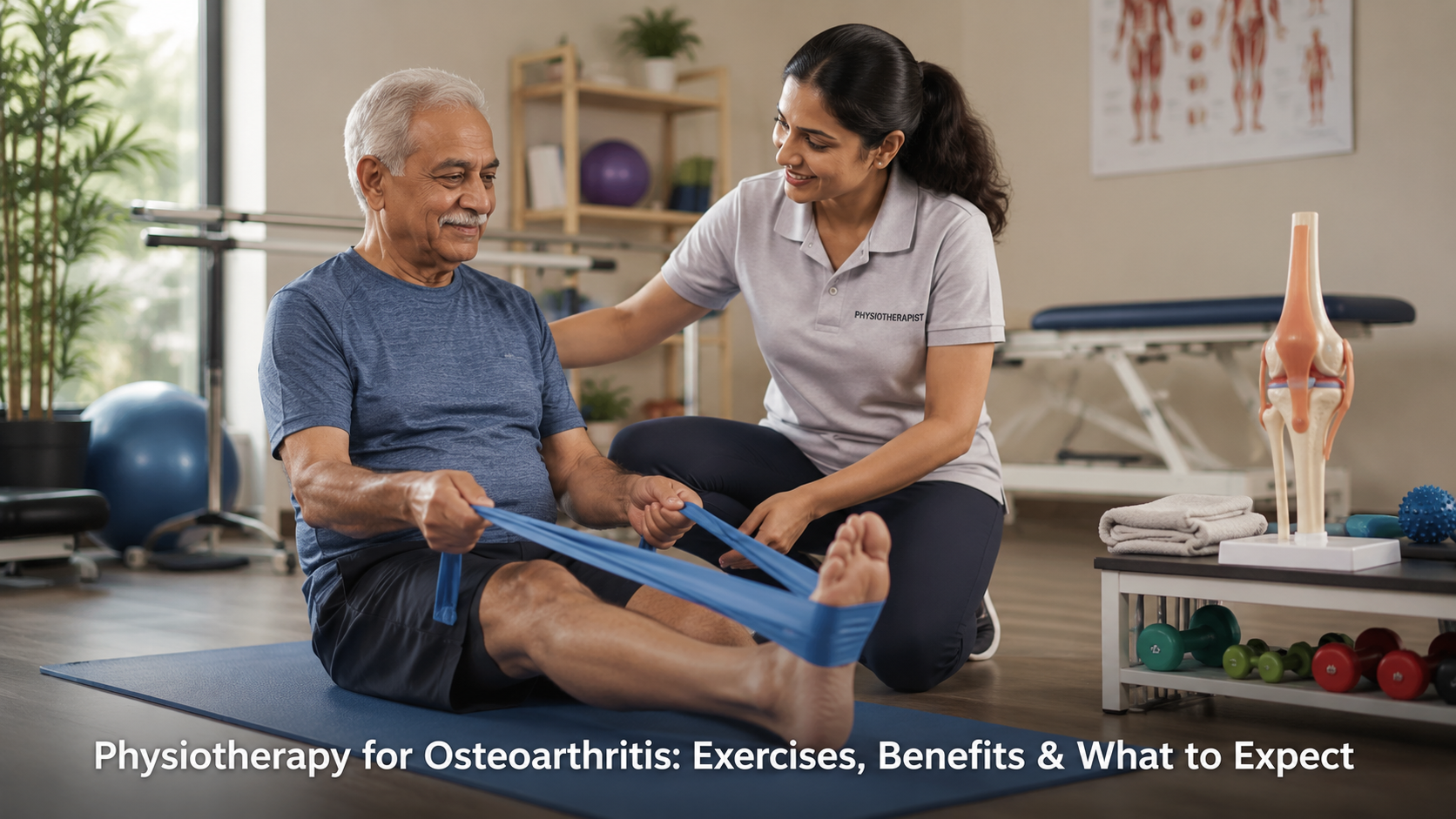
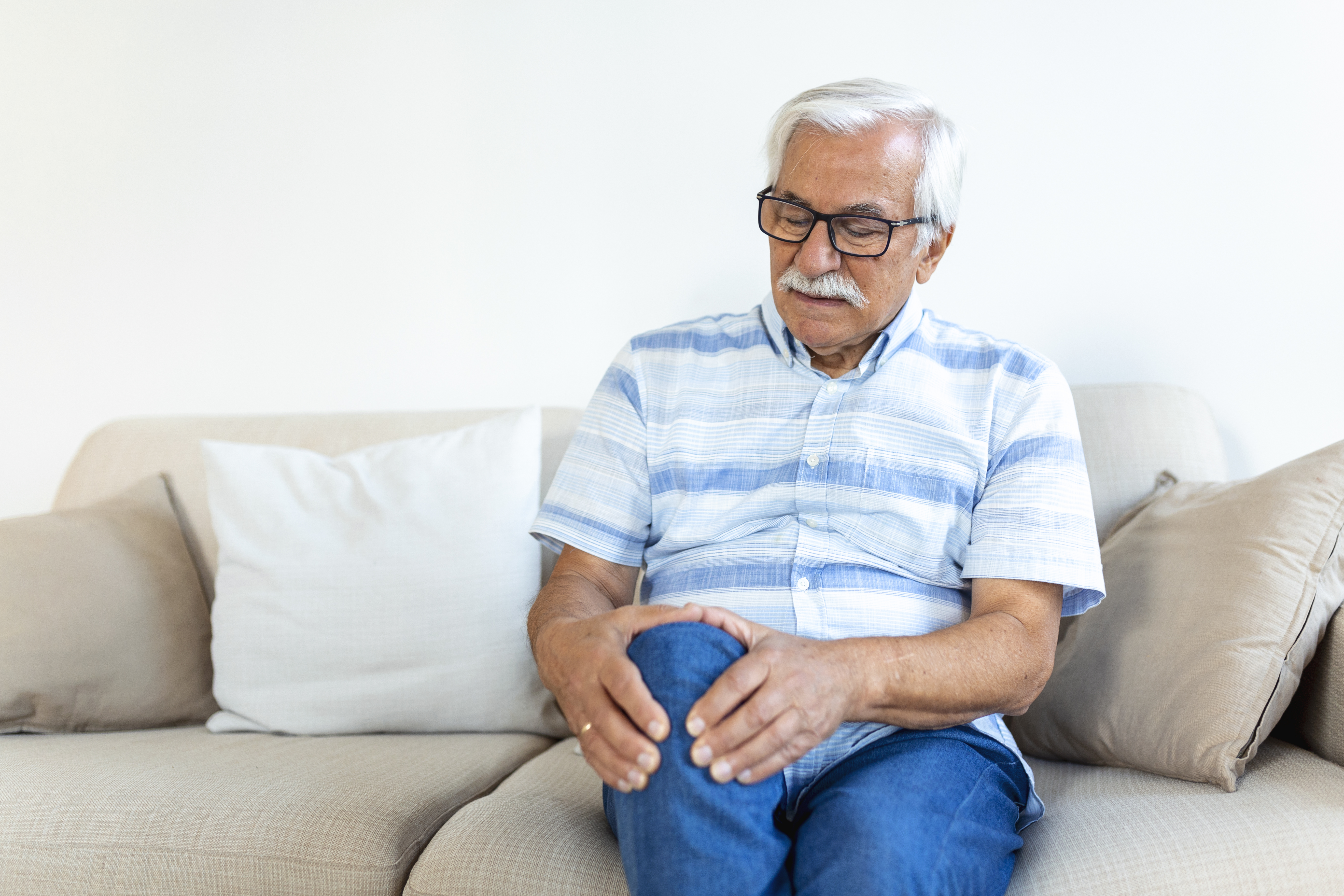
If you have crossed forty and your knees complain every time you get up from the floor, or climb the stairs to your flat, or sit cross-legged at a family function, you are not alone. And no, it is not "just age".
Most days at the clinic, I meet someone who has quietly stopped doing things. Stopped going for the evening walk. Stopped visiting the temple with the steep steps. Started sitting on a chair at weddings while everyone else sits on the floor. They come in only when the pain refuses to be ignored.
Here is what I tell each of them. Osteoarthritis is common, it is manageable, and the single most useful treatment we have is not a tablet. It is movement, taught properly. That is what physiotherapy for osteoarthritis is really about.
Let us talk it through, the way we would across the table, so you know exactly what physiotherapy for osteoarthritis involves before you book that first appointment.
Think of cartilage as the smooth cushioning at the ends of your bones. It lets the joint glide. In osteoarthritis, that cushion gradually thins and roughens. The bone underneath reacts, the joint lining gets irritated, and the muscles around it weaken. The result is pain, stiffness, and a joint that does not want to move.
It is not simply "wear and tear". That phrase does more harm than good, because it makes patients think the joint is a tyre that will finish faster if they use it. The opposite is true. Joints are living tissue. They stay healthier when they are used. That single idea sits underneath every set of osteoarthritis physiotherapy exercises we prescribe.
The numbers in our country are worth knowing. India had roughly 62.35 million people living with osteoarthritis in 2019, up from 23.46 million in 1990 (Singh A, et al., 2022). And a large community study across five Indian cities found knee osteoarthritis in 28.7% of adults overall, with Kolkata at 33.7% (Pal CP, et al., 2016). One in three. Look around your building and count.
Women are affected more often than men, and being overweight, having a sedentary job, and years of deep squatting and floor-sitting all add to the risk.
The knee leads the list by a distance, which is why most of this article talks about physiotherapy for knee osteoarthritis, and why the physiotherapy exercises for knee osteoarthritis further down get the most space.
Because the evidence behind physiotherapy for osteoarthritis is genuinely strong, and because it treats the cause rather than only the symptom.
The NHS puts it plainly: exercise is one of the most important treatments for osteoarthritis, whatever your age or fitness level (NHS, 2023). A review of 60 randomised controlled trials found that exercise gives substantial benefit compared with doing nothing (Fransen M, et al., 2015). Not a small edge. Substantial.
Here is the part that surprises people. Patient education and self-management, simply understanding your condition and how to move with it, has been shown to be 20% to 30% more effective than NSAIDs for osteoarthritis pain (Superio-Cabuslay E, et al., 1996). Knowing beats swallowing.
A painkiller quietens the alarm. Physical therapy for osteoarthritis rebuilds the support around the joint so the alarm has less reason to ring. Both have a place, but only one of them changes the trajectory.
And there is one more reason. Around a knee with osteoarthritis, the quadriceps, the big muscle on the front of the thigh, is on average about 20% weaker than normal (Slemenda C, et al., 1997). Weak thigh, more load through the joint, more pain, less movement, weaker thigh still. Well-chosen physiotherapy exercises for knee osteoarthritis break that loop.
Patients often imagine a machine, some heat, twenty minutes, done. Real physiotherapy for osteoarthritis is far more personal than that.
Your physiotherapist does a full musculoskeletal assessment. They will watch you walk. They will check how far the knee bends and straightens, test the strength of your thigh and hip muscles, look at your balance, and check whether your knee is tracking properly or drifting inward.
They will also ask about your life, not just your knee. Do you climb three floors daily? Do you sit on the floor to cook or pray? Do you work standing at a counter for eight hours? A programme that ignores your actual day is a programme you will not follow.
Sessions typically mix hands-on work with supervised exercise. Manual therapy, where the therapist stretches and mobilises the joint and soft tissue, can help, though the guidance is clear that it works alongside exercise rather than instead of it (Kus G, et al., 2023). Heat, ice, and similar comfort measures are useful add-ons, not the treatment itself.
Most of the session, and most of the benefit, is the exercise. And most of your osteoarthritis physiotherapy exercises happen at home, on the days you do not see your therapist.
Good osteoarthritis physiotherapy exercises fall into four groups. You need all four, in different amounts, depending on where you are starting from. The physiotherapy exercises for knee osteoarthritis described below are the ones we reach for most often at the clinic and together they make up a complete set of exercises for osteoarthritis knee pain.
Because the quadriceps is your knee's shock absorber. Rebuild it and the joint gets a break. This is why strengthening sits at the heart of any set of exercises for osteoarthritis knee pain.
The dose matters. Research supports a minimum of two, and ideally three, sets of 8 to 12 repetitions, done three sessions a week (Kus G, et al., 2023). Consistency over intensity.
Your therapist will likely start you with straight leg raises, where you lie down and lift the straight leg a foot off the bed; static quadriceps contractions, pressing the back of the knee into a rolled towel; and inner-range quadriceps work. As you improve, they progress you to sit-to-stand from a chair without using your hands, step-ups on a low step, wall slides, and mini squats through a range that does not hurt. Bands and light weights come in later.
A note on the sit-to-stand. It looks trivial. It is one of the best exercises for osteoarthritis knee pain there is, because it trains exactly the movement that causes you trouble.
Stiffness is often what bothers people first thing in the morning. Gentle, regular stretching handles it.
The usual ones for the knee are a hamstring stretch, sitting on the edge of a bed with one leg out straight and leaning gently forward; a calf stretch against a wall; a quadriceps stretch holding your ankle behind you while steadying yourself on a chair; and a heel-slide, lying down and sliding the heel towards your bottom to gently reclaim the bend.
Hold each for 20 to 30 seconds. No bouncing. You want a pull, never a sharp pain. Stretching exercises for osteoarthritis work best when they are boring and daily rather than heroic and occasional.
Yes. This is the question I get most, and the worry behind it is always the same: "Doctor, will walking finish my remaining cartilage?"
It will not. In adults over 50, regular walking is associated with less knee pain developing over time, and aerobic walking significantly reduces both pain and disability (Kus G, et al., 2023). The Arthritis Foundation suggests working towards 30 to 60 minutes of walking on most days at a moderate pace, roughly 2 to 3 miles an hour (Arthritis Foundation).
Start where you actually are. If ten minutes is your ceiling today, walk ten minutes. Add a couple of minutes each week. Walk on a flat, even surface, in proper cushioned shoes rather than chappals or hard leather sandals, and preferably in the morning or evening rather than in the afternoon heat.
Even running, which frightens people more, has not been shown to worsen the joint. A 2022 systematic review found middle-aged runners did not show greater imaging or clinical signs of osteoarthritis than non-runners (Kus G, et al., 2023). That does not mean go for a marathon. It means the story you have been told about movement destroying your knees is not supported by the evidence.
If land-based exercise hurts too much to start, water is your friend. Standing in shoulder-height water takes a large part of your body weight off the joint while the water itself gives resistance.
A meta-analysis of 20 studies found aquatic exercise reduces pain and improves physical function, knee extension strength, and walking ability (Kus G, et al., 2023). For heavier patients and for those with advanced arthritis, this is often the gentlest way in, and one of the most comfortable exercises for osteoarthritis knee pain to begin with.
Very useful, and culturally an easy sell in India. Yoga improves flexibility, alignment, strength and endurance. Tai chi is well regarded for balance, strength and range of motion (Arthritis Foundation).
One caution, and please take it seriously. Not every asana suits an arthritic knee. Deep knee-bending postures can aggravate things. Learn from a teacher who knows about your diagnosis, and tell your physiotherapist what you are doing.
Ask patients six months in and they rarely mention the joint first. They mention their life.
Pain settles, and often the tablets reduce. The joint moves more freely, so the morning stiffness shortens. Muscles get stronger, so stairs stop being an event. Balance improves, so the fear of falling fades, and that fear is often more disabling than the arthritis. Sleep improves. Mood improves. Weight becomes easier to manage, and every kilogram lost takes several kilograms of load off the knee with each step.
And for a good number of people, physiotherapy for knee osteoarthritis delays or avoids surgery altogether. For others it makes surgery, if it eventually comes, far more successful, because you go into the theatre with a strong leg instead of a wasted one.
Let me be honest with you, because false promises help nobody.
You will not feel different in a week. Most people notice a real change somewhere between six and twelve weeks of consistent work. Your first two weeks may even feel slightly worse as the muscles wake up. That is normal muscle soreness, and it settles.
A typical programme runs six to twelve supervised sessions, spread out, with home exercise on all the other days. The osteoarthritis physiotherapy exercises you do at home are not homework. They are the treatment. The clinic visits are where we check and progress them. The home exercise is not homework. It is the treatment. The clinic visits are where we check and progress it.
And here is the difficult part. This does not end. Osteoarthritis is a long-term condition, and the exercise is like brushing your teeth, not like a course of antibiotics. The patients who do well are the ones who keep going after they feel better.
The most common one is stopping. Pain improves, the routine slips, three months later they are back where they started.
The second is doing too much too soon. An enthusiastic patient who does fifty repetitions on day one will hurt on day two and quit on day three. Slow is fast here.
The third is expecting rest to heal it. Rest feels good for a few hours and costs you muscle over weeks.
The fourth is exercising through sharp pain. A mild ache during and shortly after exercise is acceptable. Sharp pain, or pain that is still worse the next morning, means the dose was wrong. That is worth a call to your therapist, not a reason to stop.
And the fifth, quietly the biggest, is downloading a random exercise video. Your knee is not the knee in that video. The right exercises for osteoarthritis knee pain are the ones matched to your assessment, so guidance matters.
Physiotherapy is the foundation, but it does not work in isolation. Weight management, pain relief when required, topical anti-inflammatories, occasionally an injection, walking aids or a brace, and proper footwear all sit alongside it.
Surgery is considered only when other treatments have been given a fair trial and daily life is still significantly affected (NHS, 2023). Note the order. Physiotherapy first, and for a proper duration, not two half-hearted weeks.
Please come in sooner rather than later if your knee is swollen and hot, if it locks or gives way, if the pain wakes you at night, or if it is getting rapidly worse. Those need a look.
At UniClinic, our orthopaedic consultants and diagnostic services sit under one roof at both our Kolkata and Siliguri centres. That means your X-ray, your consultation and your rehabilitation plan can be sorted in a single visit rather than three trips across town.
If your knees have been talking to you for a while, book a consultation. The earlier we start, the more we have to work with.
They carry out a full musculoskeletal assessment, checking your joint movement, muscle strength, walking pattern and balance. Based on that, they design a personalised exercise programme, teach you the correct technique, use hands-on manual therapy alongside it where helpful, advise on walking aids, braces or footwear, and progress your programme as you improve.
Yes. A review of 60 randomised controlled trials found exercise gives substantial pain relief compared with no treatment. Patient education and self-management have been shown to be 20% to 30% more effective than NSAIDs for osteoarthritis pain. Most people notice meaningful change within six to twelve weeks of consistent work.
Cut down on deep-fried items, refined sugar and sweets, refined carbohydrates such as maida, processed and red meats, and excess salt. These add to inflammation and, importantly, to weight. Alcohol is best limited. The bigger issue is usually total calories, since excess weight directly loads the knee.
Plain water first, and plenty of it. Green tea, ginger tea and turmeric milk (haldi doodh) are reasonable, comforting options with some anti-inflammatory evidence behind them. Skip sweetened aerated drinks and packaged juices. No drink treats osteoarthritis, but the right ones support the diet.
A simple, practical test. If a joint hurts more than two hours after you finish an activity than it did before, the activity was too much for you that day. Reduce the amount by roughly a quarter next time. It lets you find your own limit without needing a doctor for every decision.
Stage 1 (minor): little or no cartilage loss, minimal or no symptoms. Stage 2 (mild): visible bone spurs on X-ray, stiffness and pain after activity. Stage 3 (moderate): clear cartilage loss and joint space narrowing, frequent pain with daily movement. Stage 4 (severe): most cartilage gone, joint space very narrow, pain often at rest. Remember, the X-ray and the symptoms often disagree, and treatment follows the patient, not the picture.
Vitamin D matters most, and deficiency is very common in India even with our sunshine. Vitamin C supports cartilage collagen, and vitamin K and the B vitamins have supporting roles. Calcium matters for the bone underneath. Please get your levels tested before supplementing rather than guessing. No vitamin reverses osteoarthritis.
UniClinic Serviceable Cities
For test bookings and inquiries: Contact UniClinic
Cardiology | Endocrinology | Laparoscopic Surgery in Obstetrics & Gynecology | Gynecology & Obstetrics | General Medicine | Gynaecology | Orthopedics | Paediatrics | Diabetology | Ultrasound Imaging | Digital X-Ray | Blood Tests
Cardiology | Endocrinology | Laparoscopic Surgery in Obstetrics & Gynecology | Gynecology & Obstetrics | General Medicine | Gynaecology | Orthopedics | Paediatrics | Diabetology | Ultrasound Imaging | Digital X-Ray | Blood Tests
References & Citations
The Global Burden of Disease Study 2019. Osteoarthritis and Cartilage. 2022.
Epidemiology of knee osteoarthritis in India. Indian Journal of Orthopaedics. 2016.
Exercise for osteoarthritis of the knee. Cochrane Database of Systematic Reviews. 2015.
Quadriceps weakness and osteoarthritis of the knee. Annals of Internal Medicine. 1997.
Patient education interventions in osteoarthritis and rheumatoid arthritis. Arthritis Care and Research.
National Health Service. Osteoarthritis - Treatment. NHS UK. 2023.
World Health Organization. Osteoarthritis Fact Sheet. WHO. 2023.
Exploring the Burden of Knee Osteoarthritis in Rural South India. Cureus. 2024.
6C, Hazra Road, Near Sujata Smriti Sadan, Bakul Bagan, Kalighat, Kolkata, West Bengal 700026
90540 08864
63563 55500
70690 05888
Mon - Sat : 8am - 8pm
Sunday : 8am - 5pm
Quick Links
Company
Resources
Follow Us








.jpg)

 Meaning, Causes, Symptoms, Treatment & Types.png)