
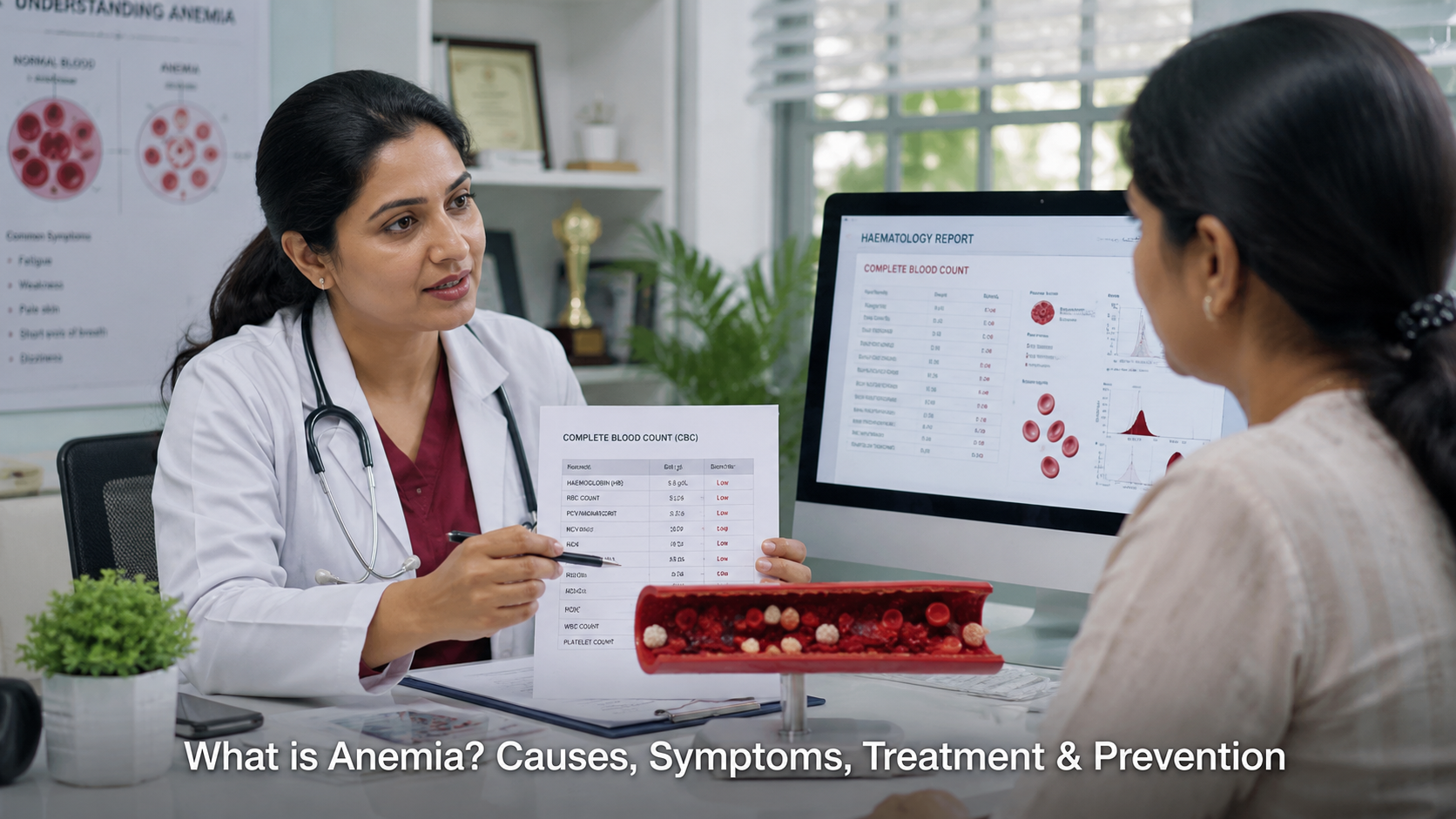
You climb one flight of stairs, and you are breathing like you have run a marathon. Your mother says you look pale. Your colleague asks why you yawn all day. And you brush it off, saying it is just the heat, just work pressure, just age.
Sit down. Let us talk about this properly.
In my years of practice, anemia is easily the most common problem I see walking through the clinic door, and it is also the most ignored one. Patients treat tiredness like a personality trait. It is not. Tiredness that does not go away after rest is your body sending a message, and often that message is about your blood.
Think of your blood as a delivery service. Red blood cells are the vans, and haemoglobin, the iron-rich protein inside them, is the driver carrying oxygen to every corner of your body: your brain, your heart, your muscles, your skin.
Anemia simply means you do not have enough healthy red blood cells, or enough good haemoglobin inside them, to carry oxygen properly. Fewer vans on the road. Slower deliveries. Your organs run on less oxygen than they need, and so they complain. That complaint is what you feel as tiredness.
So when people ask me what is anaemia in one line, I tell them this: it is not a disease of the blood alone, it is a disease of oxygen supply.
The World Health Organization treats anemia as a public health problem of the highest order, and India carries one of the heaviest loads in the world. The National Family Health Survey (NFHS-5, 2019-21) found that 57% of women aged 15 to 49 and 67% of children under five in India are anemic. Read that again. More than half our women. Two out of three of our small children.
This is not a rare condition. This is probably sitting in your own home.
Because mild anemia is quiet, and quiet things get ignored.
A woman with anemia does not collapse dramatically. She just cannot finish her housework without sitting down twice. A student with anemia does not faint in class. He just cannot concentrate and his marks slide. An older gentleman with anemia does not clutch his chest. He just feels his heart racing when he walks to the temple.
Left alone for years, anemia makes your heart work overtime, and that overtime bill eventually comes due as heart failure or arrhythmia. In pregnancy, it raises the risk of premature delivery and low birth weight babies. In children, iron deficiency in the first few years can affect brain development, and some of that damage does not fully reverse.
That is why anemia disease deserves your attention today, not next year.
Here is where most people get caught out. The early anemia symptoms are so ordinary that you blame everything else for them.
The most common signal is fatigue. Not the good tiredness after a workout, but the heavy kind, where you wake up already exhausted. Along with it comes weakness, and a strange breathlessness on small efforts. Climbing to the second floor. Carrying vegetables from the market. Playing with your grandchild for ten minutes.
Your skin may look pale or slightly yellowish, though on Indian skin this shows up better in other places. Pull down your lower eyelid and look at the inner rim. It should be a healthy pink. If it looks pale, washed out, almost white, that is a real clue. Check your nail beds and the inside of your palms too.
Then there are the ones nobody connects to blood. Headaches that keep coming back. Dizziness when you stand up too fast. Cold hands and cold feet even in Chennai weather. A heart that thumps or flutters for no reason. Brittle nails that break, or nails that curve inward like a spoon. Cracks at the corners of your mouth. Hair falling much more than usual. Difficulty concentrating, which patients describe as a fog sitting over the brain.
And one strange symptom that always confirms my suspicion: unusual cravings. If you find yourself wanting to chew ice constantly, or you feel drawn to the smell of wet mud, or you want to eat chalk or raw rice, that is a condition called pica and it is strongly linked to iron deficiency. I have had patients confess this only after I asked, because they were embarrassed. Please do not be. It is a symptom, not a habit.
These blood deficiency symptoms tend to creep in slowly. That is exactly the problem. Your body adjusts, you adjust, and one day you have forgotten what feeling normal even was.
Warning signs that need you in a clinic quickly: chest pain, severe breathlessness at rest, fainting, black tarry stools, or blood in vomit or stool. Do not wait these out.
Every case of anemia comes down to one of three stories. Either you are not making enough red cells, or you are losing them, or your body is destroying them faster than it can replace them.
Let me take you through the main anemia causes I see in Indian patients.
Iron deficiency is the big one, responsible for the majority of cases worldwide. Your body needs iron to build haemoglobin, and if the raw material is short, production stops. This happens because of poor iron intake in the diet, which is common in largely vegetarian eating patterns, or because of chronic blood loss.
Heavy periods deserve their own mention because so many women normalise them. If you are changing pads every two hours, if you pass large clots, if your period lasts beyond seven days, that is not simply "my flow is like that." That is blood walking out of your body every month, and it is one of the leading anemia causes in Indian women.
Pregnancy raises your iron requirement sharply because you are building blood for two. This is why iron and folic acid supplements are given routinely in antenatal care.
Hidden gastrointestinal bleeding worries me the most in men and in women past menopause. A slow bleed from an ulcer, from piles, from long-term painkiller use, or from a growth in the colon may show up as nothing but anemia. In these patients, anemia is a clue, not the whole answer.
Hookworm infestation is still very real in parts of rural India. The worms feed on blood in the intestine, quietly, for years.
Vitamin B12 and folate deficiency stops your bone marrow from making red cells properly. Strict vegetarians and vegans are at higher risk of B12 deficiency, since B12 comes mainly from animal foods. Some people cannot absorb B12 at all due to a condition called pernicious anemia.
Chronic diseases such as kidney failure, long-standing rheumatoid arthritis, tuberculosis, HIV, and cancer suppress red cell production. Kidney disease is special here, because damaged kidneys stop making erythropoietin, the hormone that tells your marrow to produce red cells.
Inherited conditions matter enormously in India. Thalassemia and sickle cell disease are passed down in families, and they are far from rare in certain communities. India has a large thalassemia carrier population, and sickle cell disease is concentrated in central and tribal belts. If anemia runs in your family, or if your child has been anemic since infancy despite good food, tell your doctor. This changes the whole approach.
Aplastic anemia is uncommon but serious, where the bone marrow itself shuts down production.
Certain medicines can trigger it too, including some antibiotics, antiretrovirals and chemotherapy drugs.
Not all anemia is the same, and treating them the same way is exactly how patients waste years. When we talk about types of anemia, we are really talking about the mechanism behind it.
Some of these types of anemia are temporary and fully fixable. Some are lifelong and need management rather than a cure. That difference is decided by diagnosis, not by guesswork.
This is the part patients try to skip, and it is the part that matters most.
Please, I am asking you sincerely: do not start iron tablets because a friend said they worked for her. Iron is not a vitamin you casually add. Taking iron when your problem is actually B12 deficiency, or thalassemia, or a bleeding ulcer, does two bad things. It does not fix you, and it hides the real problem while it grows.
Proper anemia diagnosis usually begins with a simple, cheap blood test.
A Complete Blood Count (CBC) is the starting point. It tells us your haemoglobin level, and it also tells us the size of your red cells through a value called MCV. That size is a big clue. Small red cells point towards iron deficiency or thalassemia. Large red cells point towards B12 or folate deficiency. Normal-sized cells with low count point elsewhere.
WHO defines anemia broadly as haemoglobin below 13 g/dL in men and below 12 g/dL in non-pregnant women, with a lower threshold of 11 g/dL in pregnancy, though your doctor will read your number alongside your symptoms and history.
From there, we go deeper depending on what we see. Serum ferritin tells us your iron stores, and it is the most useful single test for iron deficiency. Serum iron, TIBC and transferrin saturation fill in the picture. Vitamin B12 and folate levels are checked when cells are large. A peripheral smear lets us actually look at the shape of your cells under a microscope. Haemoglobin electrophoresis or HPLC is how we catch thalassemia and sickle cell disease. Reticulocyte count tells us whether your marrow is even trying to respond.
If you are a man, or a woman past menopause, and we find iron deficiency, we will almost always want to know where the blood is going. That may mean a stool occult blood test, an endoscopy, or a colonoscopy. I know that sounds alarming. But finding a small treatable problem early is a gift, not a punishment.
In some cases, when the picture stays unclear, a bone marrow examination gives us the final answer.
Here is the truth that saves people years of frustration: anemia treatment depends entirely on which type you have and what caused it. There is no single tablet that fixes all anemia.
For iron deficiency, oral iron tablets remain the mainstay. But how you take them decides whether they work. Take iron on an empty stomach if your stomach tolerates it, and swallow it with lemon water, orange juice, or amla juice, because vitamin C dramatically improves absorption. Keep it away from tea, coffee, milk and calcium tablets by at least two hours, because these block absorption. Do not panic if your stools turn black, that is normal and expected. If constipation or nausea troubles you, tell your doctor rather than stopping the tablet quietly, because alternate-day dosing often works better and is gentler.
And here is the part almost everyone gets wrong. Your haemoglobin may rise within four to six weeks, and you will feel wonderful, and you will want to stop. Do not. Your iron stores are still empty. Most patients need to continue for around three months after the haemoglobin normalises, to refill the tank. Stop early and you will be back in my clinic next year with the same complaint.
Intravenous iron is given when tablets are not tolerated, when absorption is poor, when blood loss is ongoing, or when we need to correct things fast, such as in later pregnancy.
For B12 deficiency, treatment is B12, given as injections or high-dose oral supplements depending on the cause. If absorption is the problem, tablets alone will not do the job.
For folate deficiency, folic acid supplementation works well.
For anemia of chronic disease, we treat the disease. Control the kidney failure, treat the TB, manage the arthritis, and the anemia improves alongside. Kidney patients often need erythropoietin-stimulating agents, since their kidneys have stopped sending the signal.
For thalassemia major and severe haemolytic anemia, management may involve regular transfusions and iron chelation therapy, and in selected cases, a bone marrow transplant offers a cure. This is specialist territory.
Blood transfusion is reserved for severe anemia or active heavy bleeding. It is a rescue measure, not a routine treatment.
One more thing about anemia treatment. If we treat you and your haemoglobin does not budge, that is important information. It usually means we have the wrong diagnosis or there is an ongoing loss we have not found. Come back and tell us. Do not just double the dose at home.
Now to the kitchen, where a lot of this battle is actually won.
Dietary iron comes in two forms and they are not equal. Heme iron, found in animal foods, is absorbed easily, roughly 15 to 35% of it. Non-heme iron, found in plant foods, is absorbed far less, often under 10%. Since so many Indian households eat mostly vegetarian, this single fact explains a lot of our national anemia problem.
Good sources of iron on an Indian plate include ragi, bajra, jowar, rajma, chana, moong, urad, soya, sesame seeds, pumpkin seeds, jaggery, dates, raisins, dried figs, poha, amaranth, and green leafy vegetables such as spinach, methi, and amaranth leaves. For those who eat non-vegetarian food, mutton liver, red meat, chicken, fish and prawns are the strongest sources available.
But eating iron and absorbing iron are two different things.
Pair iron foods with vitamin C, always. Squeeze lemon over your dal. Have amla, guava, orange or tomato with your meal. This one habit can multiply your absorption several times over.
Now the blockers. Tea and coffee contain tannins and polyphenols that seriously reduce iron absorption, and the Indian habit of chai immediately after lunch is quietly working against you. Shift it by an hour or two. Milk and calcium supplements compete with iron, so keep them separate from your iron-rich meal. Phytates in raw grains and legumes bind iron, which is why soaking, sprouting and fermenting your dals and grains genuinely helps. Idli, dosa and dhokla are not just tasty, they are smart.
Cooking in an iron kadai adds usable iron to your food, especially acidic dishes like sambar and tomato-based curries. Your grandmother was right.
For folate, eat leafy greens, beans, peanuts, sunflower seeds and citrus fruits. For B12, vegetarians should look at milk, curd, paneer, eggs, and fortified foods, and strict vegans will almost certainly need supplementation, because plant foods simply do not supply reliable B12.
Prevention of anemia is less about one heroic diet and more about small consistent habits plus timely checking.
Get your haemoglobin checked at least once a year if you are a woman of reproductive age, an adolescent girl, pregnant, elderly, a regular blood donor, or someone with a chronic illness. It is one of the cheapest tests available.
Treat the source, not just the number. Heavy periods need a gynaecologist's opinion. Piles need treatment. Long-term painkillers need review.
Deworm as advised, especially for children and in areas where hookworm is common. Use iodised, fortified staples where available, since India's fortification programme adds iron and folic acid to rice, wheat flour and salt in many regions. Take antenatal iron and folic acid exactly as prescribed, not on and off.
And if anemia runs in your family, get carrier screening for thalassemia before marriage or before planning a pregnancy. Two carriers can produce a child with thalassemia major, and that is a lifetime of transfusions. One blood test can prevent it.
If tiredness has become your normal, see someone. If your inner eyelids look pale, see someone. If you are breathless on stairs you managed easily last year, see someone. If your periods are heavy, if you crave ice or mud, if your nails are spooning, if there is blood in your stool, see someone.
Anaemia is common, but common does not mean harmless. And in most cases it is completely fixable, provided we find out which kind you have before we start treating it.
That part is simpler than people expect. Most anaemia is picked up on a simple CBC, and the cause usually shows up on iron studies or a B12 level. Which is exactly why you should not start iron tablets on your own. Iron will do nothing for a B12 deficiency, and it can quietly mask a bleed that needs to be found.
At UniClinic, our haematology consultants and lab sit under one roof, so you can book a consultation and have the tests done in the same visit. One trip, not three.
You are not lazy. You are not weak-willed. You may just be short of oxygen. Let us find out and fix it.
Yes, in most cases. Mild anemia that is diagnosed correctly and treated at the root cause has no effect on your lifespan at all. Once your iron, B12 or folate is restored and the cause is fixed, you go back to a completely normal life. Even lifelong conditions like thalassemia or sickle cell disease are now managed well with regular care, and patients live long, productive lives. What genuinely shortens life is untreated anemia carried for years, because your heart is forced to overwork and eventually gives up. So the answer depends less on having anemia and more on whether you treated it.
Focus on ragi, bajra, jowar, rajma, chana, moong, soya, sesame and pumpkin seeds, jaggery, dates, raisins, dried figs, and green leafy vegetables like spinach and methi. If you eat non-vegetarian food, liver, red meat, chicken, fish and prawns give you the most easily absorbed iron. But remember the pairing rule. Always add vitamin C alongside, so lemon on your dal, an orange or guava after the meal, amla in any form. And keep tea, coffee and milk away from those meals by a couple of hours. Soak and sprout your dals. Cook in an iron kadai. The combination matters as much as the food itself.
Beetroot and carrot juice with a squeeze of lemon is a good everyday choice. Amla juice is excellent, not because it is loaded with iron, but because its vitamin C sharply boosts absorption of the iron in your meal. Prune juice, dry fruit shakes made with dates and raisins, and ragi malt are all useful. Jaggery mixed in warm water is a simple traditional option. What I would ask you to cut back on is chai and coffee right after meals, because that single habit undoes a lot of good eating.
No, not on their own. Two eggs give you roughly 2 mg of iron, while an adult woman needs somewhere around 18 mg a day and even more in pregnancy. Egg yolk also contains a compound that slightly interferes with iron absorption. So eggs are a good part of your protein and B12 intake, but please do not treat them as your anemia solution. They are one piece of a much larger plate.
It is less about banned foods and more about timing. Avoid tea and coffee with or immediately after meals, because tannins block iron absorption significantly. Do not take milk, curd, cheese or calcium supplements along with your iron-rich meal or iron tablet. Go easy on excess wheat bran and raw unsoaked grains, since phytates bind iron. Cut down on alcohol, which affects folate. And limit heavily processed, low-nutrient foods that fill you up without giving you anything useful. Nothing here is forbidden forever. Just move it two hours away from your iron.
Very much so. Low iron is strongly linked to restless legs syndrome, where you get that crawling, uncomfortable urge to move your legs at night, and it ruins sleep quality. Iron also plays a role in dopamine regulation, which affects your sleep-wake cycle. Many of my patients report broken sleep, frequent waking, and waking up unrefreshed. Then they feel exhausted the whole day and blame the tiredness on poor sleep, when actually both are coming from the same iron deficiency. Correct the iron and sleep often improves within weeks.
Not directly, no. Stress does not empty your iron stores by itself. But it works around the edges in ways that matter. Chronic stress affects your appetite and eating patterns, it can worsen gut conditions that reduce absorption, it can trigger stress-related ulcers or gastritis that bleed slowly, and it can push some women's periods into heavier or irregular patterns. Long-standing inflammation also interferes with how your body uses iron. So stress is more of an accomplice than the culprit. If you are stressed and tired, please get your haemoglobin checked rather than assuming it is only your mind.
For test bookings and inquiries: Contact UniClinic
Cardiology | Endocrinology | Laparoscopic Surgery in Obstetrics & Gynecology | Gynecology & Obstetrics | General Medicine | Gynaecology | Orthopedics | Paediatrics | Diabetology | Ultrasound Imaging | Digital X-Ray | Blood Tests
Cardiology | Endocrinology | Laparoscopic Surgery in Obstetrics & Gynecology | Gynecology & Obstetrics | General Medicine | Gynaecology | Orthopedics | Paediatrics | Diabetology | Ultrasound Imaging | Digital X-Ray | Blood Tests
World Health Organization. Anaemia. WHO Fact Sheet. 2023.
World Health Organization. Haemoglobin concentrations for the diagnosis of anaemia
International Institute for Population Sciences (IIPS) and ICF. National Family Health Survey
Ministry of Health and Family Welfare,Anemia Mukt Bharat: Intensified National Iron Plus Initiative
Recommended Dietary Allowances ICMR-National Institute of Nutrition
Iron-deficiency anemia. New England Journal of Medicine.
Iron deficiency anaemia. The Lancet
Iron absorption from supplements Haematologica
Centers for Disease Control and Prevention. Iron and Iron Deficiency. CDC Nutrition
National Health Portal of India. Anaemia. Ministry of Health and Family Welfare
A. Burden of thalassemia in India: The road map for control. Pediatric Hematology Oncology Journal.
Hurrell R, Egli I. Iron bioavailability and dietary reference values. American Journal of Clinical Nutrition
Allen LH. How common is vitamin B-12 deficiency? American Journal of Clinical Nutrition
Disclaimer: UniClinic does not represent or warrant that the content or information provided through our blog is accurate, complete, or current, nor that our blog content will be uninterrupted or error-free. We do not guarantee that any defects in our blog content will be corrected, or that our or the server hosting them are free of viruses or other harmful components. UniClinic makes no warranties or representations regarding the use of materials in our blog content concerning their correctness, accuracy, adequacy, usefulness, timeliness, reliability, or otherwise, to the fullest extent permitted by applicable law. Information available via our Platform and blog content may reference products, programs, or services not available in your region. You understand and acknowledge that your sole and exclusive remedy for any defect in or dissatisfaction with our blog content is to cease using them.
6C, Hazra Road, Near Sujata Smriti Sadan, Bakul Bagan, Kalighat, Kolkata, West Bengal 700026
90540 08864
63563 55500
70690 05888
Mon - Sat : 8am - 8pm
Sunday : 8am - 5pm
Quick Links
Company
Resources
Follow Us



.jpg)

 Meaning, Causes, Symptoms, Treatment & Types.png)

