Every monsoon season brings the same wave of walk-ins: a fever that won't break, body aches, and the uneasy question of "is this just a viral fever, or something more?" In tropical and subtropical regions, the rains that bring relief from summer heat also create the perfect breeding ground for mosquitoes and waterborne bacteria — which means a spike in dengue, malaria, and typhoid alongside ordinary seasonal flu.
The trouble is that all three conditions can start out looking almost identical: high fever, headache, body pain, and fatigue. That overlap is exactly why doctors recommend a fever profile test rather than guessing based on symptoms alone. In this guide, the team at Uniclinic Health breaks down the symptoms to watch for and exactly which tests — from a malaria test to dengue markers to the Widal test for typhoid — help pinpoint the real cause of a monsoon fever.
Monsoon rains create ideal conditions for all three illnesses at once, though through very different routes:
Stagnant water in tires, containers, coolers, and construction sites becomes a breeding ground for Aedes aegypti mosquitoes, which spread dengue.
Waterlogged, humid conditions also favor Anopheles mosquitoes, the vector responsible for malaria.
Contaminated drinking water and food, common when sewage systems overflow during heavy rain, drive up cases of typhoid, which spreads through the fecal-oral route.
Because these three illnesses circulate simultaneously during the same weeks, a person with a monsoon fever could plausibly have any one of them — which is precisely why lab testing, not guesswork, is the safest way forward.
Dengue is a mosquito-borne viral infection, and dengue disease symptoms typically appear 4 to 10 days after being bitten by an infected mosquito. Common signs include:
Sudden high fever (often 104°F/40°C)
Severe headache, particularly behind the eyes (retro-orbital pain)
Muscle, joint, and bone pain — sometimes called "breakbone fever"
Nausea and vomiting
Skin rash appearing 2–5 days after fever onset
Mild bleeding, such as nosebleeds or bleeding gums
Most people recover within 1–2 weeks, but a small percentage progress to severe dengue. Warning signs that need immediate medical attention include severe abdominal pain, persistent vomiting, bleeding from the nose or gums, blood in vomit or stool, and extreme fatigue or restlessness.
Malaria is caused by Plasmodium parasites transmitted through the bite of an infected Anopheles mosquito. Malaria symptoms are often described as flu-like and nonspecific, which is part of why lab confirmation matters so much. Typical malaria symptoms include:³
Fever, often occurring in cycles (every 48–72 hours, depending on the parasite species)
Chills and shaking
Profuse sweating as fever breaks
Headache and body aches
Fatigue and general malaise
Nausea, vomiting, and diarrhea
Because these symptoms mimic dengue, typhoid, and even a common viral fever, a malaria test is the only reliable way to confirm or rule out infection — self-diagnosing by symptoms alone is not accurate enough to guide treatment.
Typhoid fever is a bacterial infection caused by Salmonella Typhi, usually contracted through contaminated food or water. Typhoid fever symptoms tend to build gradually over one to three weeks and include:
Sustained high fever that climbs day by day
Fatigue and weakness
Headache
Abdominal pain and tenderness
Constipation or diarrhea
Loss of appetite and weight loss
A flat, rose-colored rash on the chest or abdomen in some cases
Left untreated, typhoid can lead to serious complications such as intestinal bleeding or perforation after two to three weeks of illness, making early diagnosis important.
Look at the three lists above side by side, and a pattern jumps out: fever, headache, body aches, and fatigue show up in dengue, malaria, and typhoid alike. Early in the illness, even an experienced clinician often cannot tell them apart on symptoms alone. That's the entire reason a combined fever panel exists — it checks for all three (plus related markers) in a single blood draw, rather than testing for one illness, waiting on results, and starting over if it comes back negative.
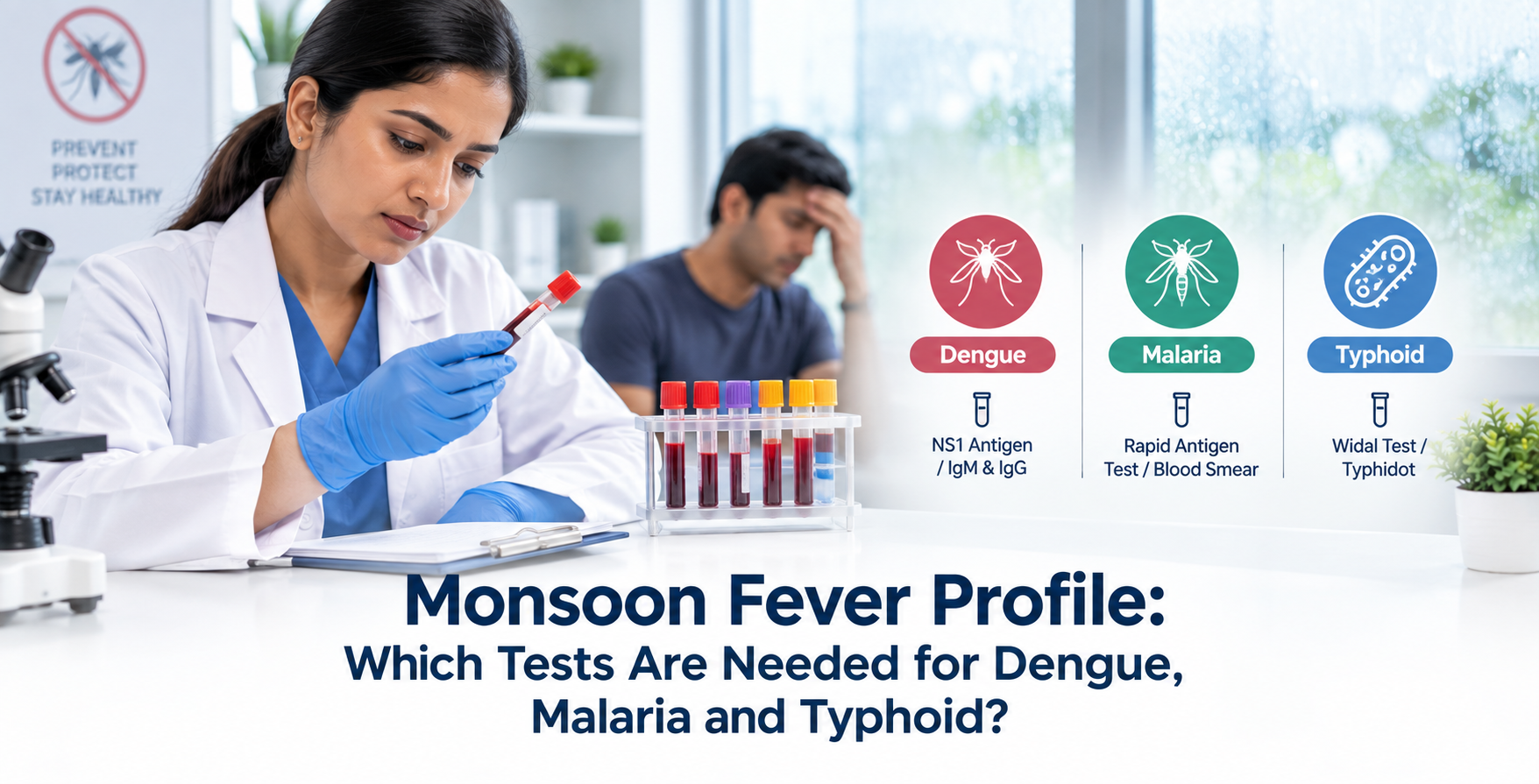
A fever profile test (sometimes called a fever panel) is a bundled set of lab investigations ordered when someone presents with an unexplained or persistent fever, especially during monsoon season. A typical panel includes:
Complete Blood Count (CBC) — checks white blood cell count, platelet count, and hemoglobin, all of which shift in characteristic ways with dengue, malaria, and typhoid
Malaria test — usually a peripheral blood smear and/or a rapid antigen test
Dengue markers — NS1 antigen (detects early infection) and IgM/IgG antibodies (detect the body's immune response)
Widal test or Typhidot — screens for typhoid-specific antibodies
Blood culture — the gold-standard test for confirming typhoid
CRP (C-reactive protein) and ESR — general markers of inflammation or infection
Liver function tests (LFTs) — dengue and typhoid can both affect liver enzymes
There are two main ways a lab confirms malaria:
Peripheral blood smear (microscopy) — A drop of blood is examined under a microscope to spot the malaria parasite directly inside red blood cells. This remains the gold standard because it can also identify which Plasmodium species is responsible.
Rapid diagnostic test (RDT) — An antigen-based test that gives results in about 15–20 minutes by detecting malaria proteins in a blood sample. A positive or negative RDT result is typically confirmed with a blood smear for accuracy.
Because parasite levels can be very low early in the infection, a single negative result doesn't always rule out malaria — doctors often recommend repeat testing over 24–48 hours if symptoms persist.
Dengue testing usually relies on two markers depending on the timing of the illness:
NS1 antigen test — most useful in the first 1–7 days of fever, when the virus is still circulating
IgM/IgG antibody test — becomes detectable later in the illness and can also indicate a past dengue infection
Blood culture is considered the most reliable method, especially in the first week of illness, though it can take a few days to yield results.
The Widal test is inexpensive and widely used, but it has known limitations — it can produce false positives, and results need to be interpreted alongside symptoms and other tests rather than on their own.
Not every fever needs lab work — a mild fever from a common cold usually resolves on its own. However, you should consider getting one if:
Fever persists for more than 2–3 days without a clear cause
Fever is accompanied by severe body aches, rash, or vomiting
You live in or have recently traveled to a dengue-, malaria-, or typhoid-prone area
Symptoms worsen instead of improving after a couple of days
You notice warning signs like bleeding, severe abdominal pain, confusion, or difficulty breathing — these need urgent medical attention, not just lab testing
While testing helps catch these infections early, prevention still matters most:
Empty and clean containers, coolers, and flowerpots that can collect standing water
Use mosquito repellents and sleep under nets or in screened rooms
Drink boiled or purified water, and avoid raw or street food during monsoon season
Wash hands frequently, especially before eating
Wear long sleeves and pants during peak mosquito activity (dawn and dusk)
Keep your surroundings and drainage systems clear of stagnant water
A standard panel typically bundles a Complete Blood Count (CBC), malaria screening (peripheral smear and/or rapid antigen test), dengue markers (NS1 antigen and IgM/IgG antibodies), a Widal test or Typhidot for typhoid, and sometimes CRP, ESR, and liver function tests. The exact combination can vary between labs and packages — some "basic" panels cover only CBC and the three primary infections, while "comprehensive" panels add inflammation markers and organ function tests. Your doctor will usually tailor the specific tests to your symptoms, how long you've had the fever, and your local disease patterns, rather than running every test by default.
The peripheral blood smear examined under a microscope is considered the gold standard for diagnosing malaria because it can directly visualize the parasite and identify the specific Plasmodium species involved, which affects treatment choice. Rapid diagnostic tests (RDTs) are faster — usually 15 to 20 minutes — and convenient for quick screening, but a positive or negative RDT result is generally confirmed with a blood smear. Because parasite counts can be very low in the early days of infection, a single negative result doesn't fully rule out malaria if symptoms strongly suggest it; doctors often repeat the test over the following one to two days.
The earliest dengue disease symptoms usually include a sudden high fever, severe headache (often felt behind the eyes), and intense muscle and joint pain — which is why dengue has earned the nickname "breakbone fever." Nausea, vomiting, and fatigue often follow within the first couple of days, and a skin rash may appear between days 2 and 5 of the fever. Because these early symptoms overlap heavily with malaria, typhoid, and even the flu, a dengue NS1 antigen test in the first week of fever is the most reliable way to confirm the diagnosis early, when it matters most for monitoring.
Yes — co-infection with typhoid and malaria is possible, particularly in regions where both diseases are common and transmission routes overlap during monsoon season. This is actually one of the strongest arguments for ordering a combined fever panel rather than testing for a single illness: if a patient is treated only for malaria based on symptoms but actually has a simultaneous typhoid infection (or vice versa), the untreated illness can worsen while the other is being managed. A comprehensive panel reduces the chance of missing a co-infection that symptom-based diagnosis alone would overlook.
You should see a doctor if fever lasts more than two to three days, is very high (above 103°F/39.4°C), or is accompanied by symptoms such as a rash, persistent vomiting, severe body or abdominal pain, bleeding from the nose or gums, or unusual drowsiness or confusion. You should also seek care promptly if you have recently traveled to or live in an area with known dengue, malaria, or typhoid activity, since early testing and treatment significantly reduce the risk of complications. When in doubt, it's safer to get tested early than to wait and see, especially during peak monsoon transmission season.
Dengue, malaria, and typhoid can look nearly identical in their first few days — but they're treated very differently, and delaying the right diagnosis can allow any of the three to progress to a more serious stage. If you or a family member has a fever that isn't improving, don't wait it out. At Uniclinic Health, our physicians can evaluate your symptoms and order the right diagnostic panel to get you an accurate diagnosis and the appropriate treatment, fast.
World Health Organization (WHO) — Dengue and severe dengue.
Centers for Disease Control and Prevention (CDC) — Clinical Features of Dengue.
Mayo Clinic — Dengue fever: Symptoms and causes.
Centers for Disease Control and Prevention (CDC) — Clinical Guidance for Typhoid Fever and Paratyphoid Fever.
Centers for Disease Control and Prevention (CDC) — Evaluation and Diagnosis of Malaria.
Mayo Clinic — Typhoid fever: Diagnosis and treatment.
StatPearls, National Library of Medicine (NCBI) — Typhoid Fever.
For test bookings and inquiries: Contact UniClinic
Cardiology | Endocrinology | Laparoscopic Surgery in Obstetrics & Gynecology | Gynecology & Obstetrics | General Medicine | Gynaecology | Orthopedics | Paediatrics | Diabetology | Ultrasound Imaging | Digital X-Ray | Blood Tests
Cardiology | Endocrinology | Laparoscopic Surgery in Obstetrics & Gynecology | Gynecology & Obstetrics | General Medicine | Gynaecology | Orthopedics | Paediatrics | Diabetology | Ultrasound Imaging | Digital X-Ray | Blood Tests
Disclaimer: UniClinic does not represent or warrant that the content or information provided through our blog is accurate, complete, or current, nor that our blog content will be uninterrupted or error-free. We do not guarantee that any defects in our blog content will be corrected, or that our or the server hosting them are free of viruses or other harmful components. Unphysiotherapy for knee osteoarthritis UniClinic makes no warranties or representations regarding the use of materials in our blog content concerning their correctness, accuracy, adequacy, usefulness, timeliness, reliability, or otherwise, to the fullest extent permitted by applicable law. Information available via our Platform and blog content may reference products, programs, or services not available in your region. You understand and acknowledge that your sole and exclusive remedy for any defect in or dissatisfaction with our blog content is to cease using them.
6C, Hazra Road, Near Sujata Smriti Sadan, Bakul Bagan, Kalighat, Kolkata, West Bengal 700026
90540 08864
63563 55500
70690 05888
Mon - Sat : 8am - 8pm
Sunday : 8am - 5pm
Quick Links
Company
Resources
Follow Us






.jpg)


 Meaning, Causes, Symptoms, Treatment & Types.png)